
- Madaraka Express Celebrates Eight Years of Transformative Operations, Eyes Expansion and Enhanced Services
Kenya’s Standard Gauge Railway (SGR), popularly known as the Madaraka Express, on Tuesday marked eight years of safe and transformative operations, with the Kenya Railways Corporation (KRC) unveiling major milestones in localization, capacity expansion, and future growth plans.
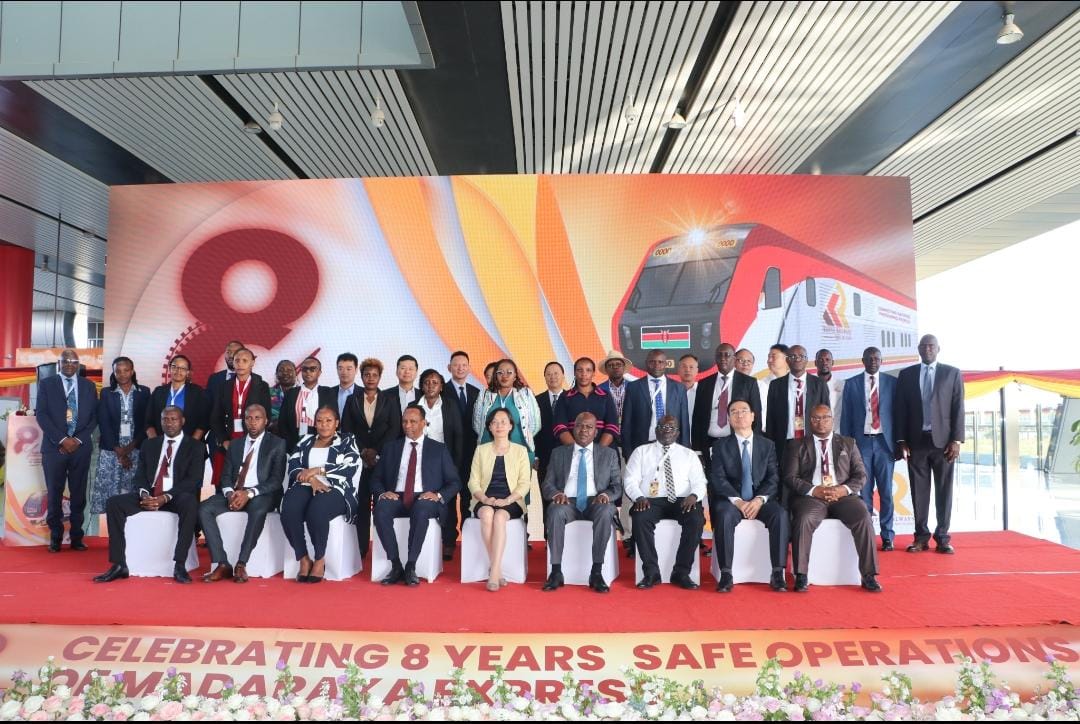
The anniversary celebration, held at the Nairobi SGR Terminus, showcased the railway’s significant contributions to Kenya’s economy, tourism, and logistics sectors.
KRC Managing Director, Mr. Philip Mainga, expressed pride in the journey of the Madaraka Express:
“We have been able to operate and manage the SGR successfully and safely for eight years without any major inconvenience.”
He announced that SGR operations are now nearly 100 percent localized, with most Chinese staff phased out and the remaining expected to exit by December 2025.
“Localization and enabling our young people to work with us; creating talent and transferring skills has been successfully implemented,” he added.
To meet growing demand, 500 new wagons have been added, and a new premium class service introduced, which Mr. Mainga described as one of the best passenger service coaches in Africa.
In 2024 alone, cargo volumes rose by 30 percent, with an additional one million tons transported compared to the previous year. Passenger numbers also surged, expected to hit 2.6 million annually, up from the previous 2.3 to 2.4 million.
This growth contributes an estimated 2 to 3 percent to Kenya’s GDP, underlining the SGR’s rising economic impact.
The Madaraka Express has revolutionized travel between Nairobi and Mombasa, reducing the journey time to five hours by train—a stark contrast to eight hours by bus and up to 26 hours by road for cargo.
KRC has also launched 20 refrigerated containers, enabling the export of perishables such as flowers, avocados, meat, and fish at temperatures as low as minus 8 degrees Celsius, directly connecting Kenyan producers to Europe and Asia.
To further enhance convenience, a seamless passenger transfer service between the Mombasa Terminus and Mombasa Island is set to launch by the end of June or early July.
“Eight out of ten tourists will tell you they came by SGR,” noted Mr. Mainga, citing increased travel to destinations like Tsavo and the Maasai Mara, thanks to new stations and connections such as Suswa.
KRC Board Chairman, Mr. Abdi Bare, emphasized the SGR’s efficiency and safety record, “We move the equivalent of 120 buses (7,250 passengers) and 1,000 twenty-foot containers between Nairobi and Mombasa daily, with zero accidents in eight years.”
Looking ahead, Mr. Mainga reaffirmed the government’s commitment to extend the railway to Malaba via Kisumu (Phases 2B and 2C). Relocation action plans and environmental assessments are near completion, with financing discussions ongoing.
“We expect to secure funding solutions before the end of the year,” confirmed Mr. Mainga.
KRC is also advancing plans under the LAPSSET Corridor Project, which will connect Lamu Port to Ethiopia and South Sudan, further expanding Kenya’s regional trade influence.
In addition, repairs on the metre-gauge railway line damaged by floods in Kijabe are 50 percent complete, with full restoration expected by year-end. To accommodate rising demand on the Nairobi–Mombasa route, a fourth passenger train, likely an evening or night service, is planned for launch later this year.
Chinese Ambassador to Kenya, Guo Haiyan, described the SGR as a shining symbol of the alignment between Kenya Vision 2030 and the Belt and Road Initiative. She lauded the project for its role in boosting trade, transforming lives, and acting as a bridge of friendship between Kenya and China.