

Kenya has invited China and Japan among other international development lenders to finance a $2 billion (Sh258.56 billion) expansion of Nairobi’s Jomo Kenyatta International Airport (JKIA), nine months after cancelling a deal with India’s Adani Group following the indictment of its founder in the United States.
Transport Cabinet Secretary Davis Chirchir said the government had contacted several agencies, including the Japan International Cooperation Agency (JICA), China Exim Bank, German lender KFW, the European Investment Bank (EIB) and the African Development Bank (AfDB), to fund the long-delayed project.
He told reporters that letters had already been sent to the institutions outlining the opportunity to finance the project directly through the airport’s balance sheet. “We have written to development agencies to basically tell them there’s an opportunity to build the airport through the Jomo Kenyatta International Airport, borrowing on its balance sheet,” Chirchir said.
The expansion plan, which has been on the table for more than a decade, includes the construction of a second runway and a new terminal building. Once financing is secured, the government will then seek a contractor to execute the works. “Instead of bringing concessionaire to build the airport, we build the airport that we can concession later,” Chirchir said.
Under the cancelled deal with the Adani Group, the Indian conglomerate was to finance, build and operate the expanded facility for 30 years before transferring it back to the government.
The project was abandoned last year after US prosecutors charged Adani and several executives with paying bribes to secure power contracts in India and misleading investors. The Adani Group has dismissed the allegations as “baseless” and said it is cooperating with legal processes. The revival of the JKIA expansion project comes as Kenya faces mounting infrastructure financing pressures. With public debt exceeding Sh11.5 trillion, the government has shifted towards alternative funding models that tap both domestic and external markets without adding directly to sovereign debt.
Chirchir said the use of the airport’s own balance sheet to secure loans would help ring-fence the liabilities from the central government’s books.
In parallel with the airport talks, Kenya will issue a securitised bond worth Sh175 billion ($1.36 billion) next month to fund road construction. The bond will be backed by a portion of the fuel levy charged to motorists and split into two tranches — one for the local market and another for offshore investors.
“We will securitise a portion of the fuel levy… It will be split into two halves for both a local and an offshore listing,” Chirchir was quoted saying by Reuters.
He added that it was still too early to determine in which foreign market the international tranche would be offered.
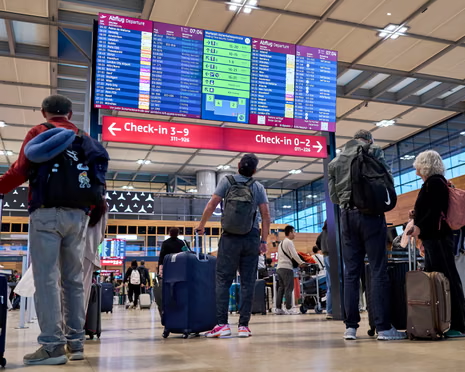
JKIA is East Africa’s busiest airport, handling over eight million passengers annually before the pandemic and serving as a key hub for Kenya Airways and other regional carriers. However, it has struggled with congestion and ageing infrastructure, with only one runway in operation and limited terminal capacity.
Plans for a second runway and new terminal have been proposed since the early 2010s, but successive funding arrangements have failed to take off.
The government hopes the involvement of multilateral development financiers will give the project the credibility and favourable loan terms needed to push it forward. Agencies like JICA and the AfDB have previously financed major transport projects in Kenya, including port expansions, highways and urban commuter rail systems.
Chirchir’s comments also signal a strategic shift in how Kenya approaches large-scale infrastructure.
By financing and building assets through state-owned enterprises such as the Kenya Airports Authority, the government can later concession the completed facilities to private operators to recoup costs, rather than relying on long-term public-private partnerships from the outset.