

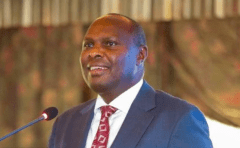
Felix Koskei during a past event.[Courtesy]
Universities and research institutions have been challenged to stop piling up academic papers and instead convert their work into enterprises and jobs.
Head of Public Service Felix Koskei on Friday said Kenya must break barriers between academia and industry to ensure research addresses food security, health, and employment.
“Our challenge is not producing more research papers. It is ensuring that research translates into production, enterprise, food sufficiency, better health outcomes, and transformative mindsets,” said Koskei.
He spoke in Mombasa at the opening of the fourth Commercialisation and Entrepreneurial Institutions Leaders’ Summit (CEIL 2025), co-hosted by the Kenya National Innovation Agency and the State Department for Science, Research and Innovation.
Koskei said the government is strengthening the innovation ecosystem through the State Department for Science, Research and Innovation, created by Executive Order No. 1 of 2025 to coordinate research, mobilise funding, and ensure impact.
As part of the summit, Koskei launched student-led innovation clubs in 11 universities, including the University of Nairobi, Daystar, Riara, Maasai Mara, Dedan Kimathi, Pwani, Meru University, Kabarak, KCA, Zetech, and United States International University–Africa.
“These clubs will incubate creativity and enterprise, empowering students to create scalable solutions while strengthening Kenya’s innovation pipeline,” said Koskei.
Kenya National Innovation Agency Chief Executive Tonny Omwansa said the summit also marked the creation of a national network of entrepreneurial leaders, the rollout of a shared technology transfer service, and plans to raise $100 million for innovation funding.
Principal Secretary for Science, Research and Innovation, Shaukat Abdulrazak, observed that Kenyan universities produce only 25 to 50 patents annually and called for reforms to increase output.
CEIL 2025 brought together more than 250 delegates, including 19 vice chancellors, 14 deputy vice chancellors, 44 senior faculty, 34 technology transfer officers, over 30 industry partners, and 40 speakers.
“This is the moment to move from dialogue to action. Kenya and Africa must position themselves not as consumers of global innovation, but as creators of solutions for the world,” added Koskei.