
Somalia’s president, Hassan Sheikh Mohamud, has announced a plan to introduce the Kiswahili language to the national curriculum.
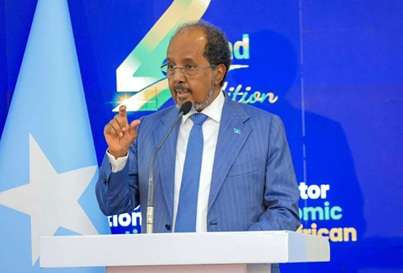
In a statement at the East African Community (EAC) summit in the capital, Mogadishu, President Mohamud said Kiswahili should also be taught at schools and universities.
English is used as the language of instruction for most subjects at Somalia’s secondary schools. Arabic is the only compulsory second language taught.
“The country’s universities, especially the Somali National University, should focus more on developing the Swahili language, which is the language of East Africa,” Mohamud said.
Somalia officially joined the eight-member EAC last year, looking forward to boosting economic growth.
“Adopting Swahili is important for our integration into the region,” Mohamud said.
kiswahili, one of the world’s most widely spoken languages with more than 200 million speakers, is growing in influence outside East Africa in its bid to become a language for all of Africa.
At the EAC meeting, Somalia’s education minister, Farah Sheikh Abdulkadir, said the government had plans to adopt Kiswahili nationwide.
“We want to see Swahili become a language of communication, trade and learning – even replacing English during our next conference,” he said at the EAC gathering.
Until 2016, Arabic was the language of instruction in Somalia at junior schools, while English was used for secondary and higher levels.
Now, the primary school national curriculum is taught in Somali, while the remaining one is taught in English for higher education.
Arabic is used at madrassas or Islamic schools.