
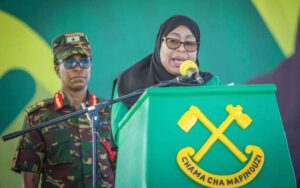
President Samia Suluhu Hassan
By Shadrack Nyakoe
Tanzania’s National Electoral Commission has declared President Samia Suluhu Hassan the winner of the country’s general election, granting her a sweeping 97.66 percent of the vote. The announcement, made on Saturday, cemented the ruling Chama Cha Mapinduzi (CCM) party’s six-decade grip on power. Yet the mood across the nation tells a far different story. Streets in several cities remain engulfed in unrest, with protesters rejecting the result as a “coronation” rather than a genuine democratic contest.
The election, held on October 29, saw an estimated turnout of 87 percent among the 37.6 million registered voters. While official figures depict a decisive victory for President Hassan, opposition parties and human rights observers have cast serious doubt on the legitimacy of the process. Two major opposition parties—Chama Cha Demokrasia na Maendeleo (CHADEMA) and the Alliance for Change and Transparency (ACT-Wazalendo)—were barred from participating, effectively leaving Hassan to face only minor challengers. CHADEMA’s leader, Tundu Lissu, was disqualified earlier this year after refusing to sign what he called a restrictive code of conduct, and later faced treason-related charges that kept him off the ballot.
The days following the vote have been marred by violence and chaos. Demonstrations erupted almost immediately in Dar es Salaam and Mwanza before spreading to other regions. Protesters clashed with police, torched campaign posters, and blocked roads as anger over the election results intensified.
Witnesses report that security forces responded with tear gas, rubber bullets, and live ammunition. The United Nations human rights office said it had received credible reports that at least 10 people were killed, but the opposition claims the toll is far higher—possibly reaching 700 nationwide, including hundreds in Dar es Salaam alone.
Authorities have dismissed those numbers as exaggerated and insisted that the election was peaceful, with only “isolated incidents of disorder.” Still, the government has imposed a nationwide curfew, ordered civil servants to stay home, and restricted access to the internet and social media platforms in an effort to quell dissent and prevent the coordination of further protests.
International reaction has been swift. UN Secretary-General António Guterres expressed deep concern over reports of killings and injuries, urging Tanzanian authorities to respect human rights and ensure accountability for any abuses. Human rights organizations, including Amnesty International and Human Rights Watch, have called for independent investigations into the conduct of security forces and the fairness of the electoral process.
For many Tanzanians, the election marks a defining moment in the country’s political history. The CCM, which has ruled since independence in 1961, now faces growing questions about its democratic credentials. Analysts note that the staggering 98 percent margin is virtually unprecedented in recent African elections, raising doubts about electoral competition and transparency.
As the dust settles, the challenge for President Hassan will be to translate her overwhelming numerical victory into genuine legitimacy. The unrest underscores a deep erosion of public trust and signals that many Tanzanians feel increasingly alienated from political institutions. Whether the government chooses dialogue and reform or doubles down on control will shape the nation’s stability for years to come.