

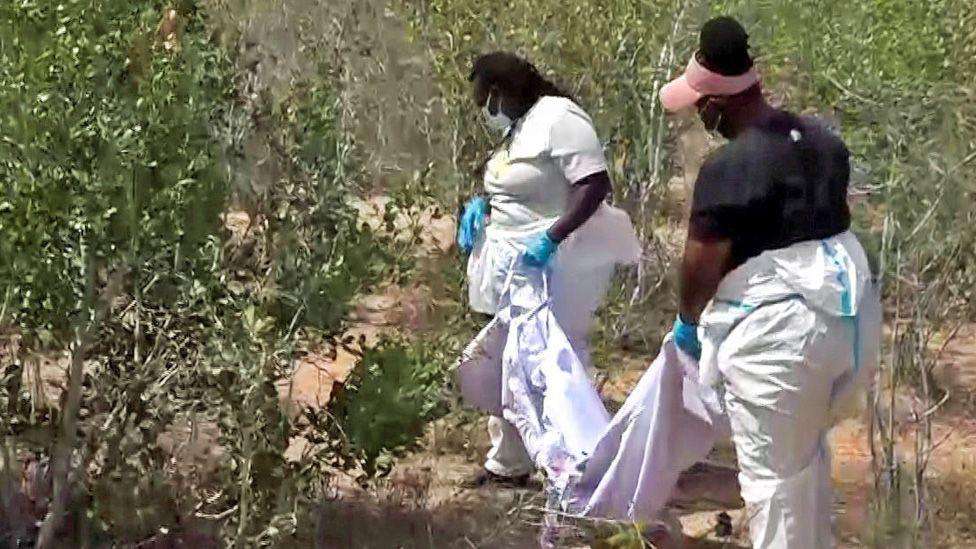
Inspector General of Police Douglas Kanja has confirmed the arrest of 11 suspects linked to the Kwa Binzaro massacre, where 34 bodies have so far been exhumed from shallow graves.
Speaking during an inspection of the sites in Kilifi County, Kanja revealed that police have recovered a total of 102 human remains, including skulls.
He added that four of the suspects in custody have been identified as the prime suspects, noting that the Directorate of Criminal Investigations (DCI) has intensified efforts to uncover the cause and motive behind the killings.
Preliminary investigations indicate that the majority of the victims of the Kwa Binzaro massacre are suspected to be non-locals.
“The investigators are actually on top of that, and very soon we’re actually going to get to know what really happened, but we are aware that many of the people who have been brought here were procured from Asia; they are not locals. They are from other places, brought here radicalised and then at the end of the day they lost their lives that way,” he said.
The arrests followed a complaint filed by a woman who reported the deaths of her children. Police told the Malindi law court that the suspects will remain in custody for one more month to allow investigations, including tracing money transfers on their phones, suspected of having funded the group’s activities.
Court documents also show the suspects paid rent in houses in Malindi town before moving to the isolated Chakama Ranch in Kwa Binzaro, where they set up mud huts next to which the graves were found.
Those under investigation have been identified as Jairus Otieno Odere, Lilian Akinyi, Kahonzi Katana Karisa, Loice Zawadi, Safari Kenga Nzai, Karisa Gona Fondo, Gona Charo Kalama, Kahindi Kazungu Garama, Thomas Mukonwe, James Kahindi and Sharleen Temba Anido.
They are facing allegations of organised crime, radicalisation, aiding terrorism and murder.
This follows the National Police Service’s (NPS) admission last week that shortcomings in handling the Kwa Binzaro tragedy were due to gaps in intelligence, investigations and coordination among security agencies.
Despite lessons being learned from the Shakahola tragedy, which shocked the country last year, police spokesperson Michael Muchiri said that a similar situation has once again unfolded, raising questions over preparedness and response.
Exhumations at Kwa Binzaro have been suspended to allow DNA analysis of the collected samples. Government pathologist Dr Richard Njoroge said that post-mortem examinations would begin once X-rays of the bodies had been completed.
Kanja noted that a multi-agency team is present to uncover the truth.
“We have our best team working here, and we will soon complete the investigation,” he told journalists.
He also admitted that the vast size of Chakama Ranch made policing difficult.
“This is a very expansive and forested area, and for that reason, we all need to work together to overcome these challenges” he said.

