

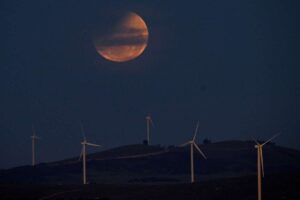
A full moon, also known as the “Blood Moon,” is seen during a partial eclipse in the sky over Lake George near the Australian capital city of Canberra on March 14, 2025.[Courtesy]
By Kimberly Kalusi
Sky watchers are in for a celestial treat on Sunday night as a total lunar eclipse, commonly known as a “Blood Moon”, will cast its glow across much of Asia, parts of Europe, Africa, and western Australia.
The spectacle occurs when the Sun, Earth, and Moon align perfectly, with Earth’s shadow falling on the Moon and giving it a dramatic deep-red hue. The striking colour, which has fascinated humans for centuries, is the result of sunlight filtering through the Earth’s atmosphere before reaching the lunar surface.
Observers in India, China, and other parts of Asia will enjoy the clearest views of the full eclipse. Eastern Africa and western Australia will also be able to see the entire event. In Europe and Africa, the Moon will rise during the eclipse, offering only a partial glimpse. The Americas will miss out entirely this time.
According to astronomer Ryan Milligan of Queen’s University Belfast, the reddish tint comes from the way Earth’s atmosphere scatters sunlight. “Shorter blue wavelengths are dispersed more easily, leaving longer red wavelengths to reach the Moon, which makes it appear bloody red,” he explained.
Unlike solar eclipses, no special equipment is required to view a lunar eclipse — just clear skies and the right location. The total phase of Sunday’s eclipse will run from 17:30 GMT to 18:52 GMT.
The last total lunar eclipse happened in March 2025, while the previous one was seen in 2022. Milligan, who has travelled the world to witness a dozen eclipses, says he considers this event a warm-up to a rare total solar eclipse coming next year.
That solar eclipse, set for August 12, 2026, will be visible in a narrow path across Spain and Iceland, marking the first total solar eclipse in mainland Europe since 2006. Outside this path, much of the continent will still see a significant partial eclipse.