

By Shadrack Nyakoe
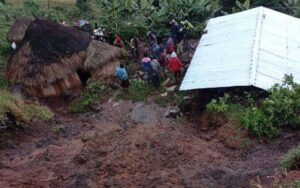
At least ten people have been confirmed dead after a landslide swept through Moror Village and Chesongoch Centre in Elgeyo Marakwet County in the early hours of Saturday, following a night of relentless rainfall.
Kerio Valley Sub-County Police Commander Zablon Okonyo said the disaster struck with such force that parts of the affected area remain cut off, hampering rescue and evacuation efforts. Despite blocked roads and unstable ground, emergency teams continue to battle their way through the debris to reach survivors.
Elgeyo Marakwet Deputy Governor Wesley Rotich said the county has mobilised ambulances, medical teams and community volunteers from neighbouring sub-counties to support the rescue operation. The Kenya Red Cross has also deployed its disaster response units to help trace missing persons, offer first aid and provide relief support to displaced families.
This tragedy is the latest in a string of landslides that have haunted the region over the years. Experts say decades of unchecked farming, deforestation and inadequate soil protection have left the hilly terrain fragile and prone to collapse during heavy rains.
In May last year, a landslide in Tuturung Village, Marakwet East, claimed two lives when it struck a retired teacher’s homestead shortly after 2 a.m. In 2020, intense rainfall triggered another deadly slide along the West Pokot Elgeyo Marakwet border, killing 29 people, injuring many others and forcing 4,000 residents from their homes. That incident occurred in the afternoon, a timing that allowed many to flee after neighbours raised alarms a factor experts believe spared the region an even greater loss of life.
Soil scientist Professor Wilson Ng’etich noted that when mud and rocks break loose from the steep highlands, the devastation is often felt many kilometres downhill. “The force of the water and debris in places like Liter and Chesogon has swept away homes, livestock, schools, even police stations and post offices,” he recalled.
The most catastrophic landslide to hit this region happened in November 2019. Fifty-two people were killed, and more than 22,000 households in villages including Parua, Nyarkulian, Sebit, Muino, Tamkal and Batei were displaced. Homes, farmlands and public infrastructure were destroyed, leaving scars still visible today.
Saturday’s incident has reignited calls for long-term interventions from relocation of high-risk communities to large-scale soil conservation, reforestation and improved land management practices. As rescue operations continue in Moror and Chesongoch, county officials and humanitarian agencies warn that without permanent solutions, such tragedies will keep recurring with every heavy downpour.