


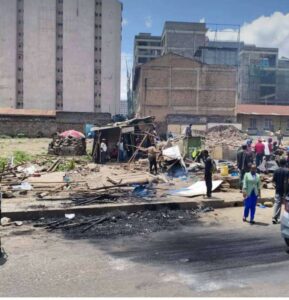
Tensions flared in Ngara on Wednesday when over 2,000 stalls at the bustling Fig Tree Market were demolished in the early hours of the morning, leaving hundreds of unsuspecting traders in shock.
The demolition, reportedly linked to a private developer, sparked outrage and despair when business owners awoke to find their long-standing stalls — some of which had been in place for over ten years — reduced to rubble, destroying their livelihoods.
In the hours that followed, stunned and furious traders took to the streets. They blocked major roads with stones and debris, lit tyres, and demanded answers in a tense standoff with police. Amid the confusion, reports of looting emerged, adding insult to injury.
For Job Wang’ombe Githuku, who has run his business in Ngara since 2012, the experience was nothing short of traumatic.
“We heard rumours the night before, but there was no formal notice. Everything we owned — stock, furniture, records — was inside when they destroyed the stalls. It’s all gone,” he said.
Githuku added that the demolished stalls were on land managed by the Nairobi City County, and that traders had been paying regular operating fees to the government.
“I know this place has its issues, but we’ve paid our dues. There has to be a better way than destroying people’s businesses in the dark,” he said.
Nearby, Felix Wanyonyi combed through what was left of his stall. He, like many others, had nowhere else to go — no backup plan, no compensation, and no relocation offered.
“We don’t have a problem with the developer. But there was no dialogue. They should have given us time or shown us where to go. You can’t just come and treat people like squatters,” he said.
Wanyonyi also pointed out that most of the traders were legitimate, paying Sh200 weekly to the county, in addition to other taxes.
Across the demolished site, heartbroken vendors — some in tears — tried to salvage whatever they could from the debris. Many said the demolition team had arrived under the cover of night, accompanied by private security and allegedly “goons,” and began fencing off key roads and access points without a word.
Traders say the market had previously been earmarked by President William Ruto for improvement. During a past public address, he promised to build a modern market to support hawkers and small traders operating from Fig Tree.
That promise gave hope to many — including James Wamuthoni, the market chairperson and a Ngara resident of over 40 years.
“We believed the President when he said he’d build us a market. We thought one day we’d have something legal, permanent — a place to call ours. Then suddenly, we’re told a developer owns the land, and everything is gone — no notice, no conversation,” he said.

According to Wamuthoni, the developer arrived overnight with police and other officials, and by sunrise, the market had been flattened.
“There are over 30,000 people who rely on this market,” he said. “Some stalls are only four feet wide — but they feed families. We are not criminals. We are citizens.”
Long-time trader Waroi Mwai, who’s been at Fig Tree since 2013, echoed the feeling of betrayal. He said that a meeting had allegedly been held with the developer at DDC Kariokor, where traders agreed to give way once construction began — but with time and preparation.
“We agreed that we’d move once the structure was ready. He said he’d only build on the agreed section. But this morning, he fenced everything — even 100 metres outside the boundary we discussed,” Mwai said. “We were given no warning. We lost everything — stock, food, personal belongings,” he said.
He stressed that while the developer may have bought a portion of the land, most of the area affected falls under the county, and traders have the receipts to prove their legitimacy.
“We are not asking for handouts — we just want to be treated with dignity,” he said. “This was our livelihood,” he added.
“Now, with stalls destroyed and no alternative in place, the traders face a grim and uncertain future. There has been no official relocation plan, no public explanation from county officials, and no compensation. For many, the stalls were their only source of income — their daily bread, their children’s school fees, and their dignity. Even if it’s just one foot of land — we just need somewhere to sell our goods,” said Wamuthoni. “We’re not asking for palaces. We just want a chance to live.”
The traders are now appealing to President Ruto, Nairobi Governor Johnson Sakaja, and their elected leaders to intervene — not just with words, but with action. They are demanding a transparent process, respect for the law, and urgent support to rebuild their lives.