

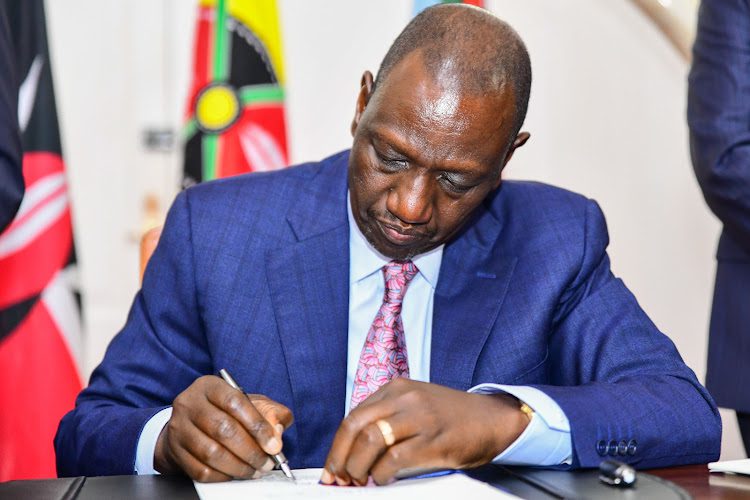
President William Ruto has officially signed the contentious Finance Bill 2025 into law, just days after it received approval from the National Assembly. The signing, conducted during a brief ceremony at State House, Nairobi, marks the formal enactment of a law that has once again sparked nationwide debate and public unrest.
Present at the event were key parliamentary figures from both the Majority and Minority sides, signaling political consensus on paper, though public sentiment remains sharply divided. The law’s passage follows commemorative protests led by Gen Z demonstrators, who brought central Nairobi to a standstill in recent days, an echo of the mass demonstrations that erupted in 2024, which ultimately forced the President to withdraw that year’s Finance Bill.
The Finance Act 2025 introduces new fiscal measures intended to boost domestic revenue collection and stabilize government spending. Although its full implications are yet to be felt, early indicators suggest it could introduce fresh cost burdens to ordinary citizens amid already challenging economic conditions.
Simultaneously, President Ruto signed the Appropriations Bill 2025 into law, authorizing the National Treasury to draw up to Ksh1.88 trillion from the Consolidated Fund for the 2025/2026 fiscal year. This move ensures continuity of government services and programmes across sectors such as health, infrastructure, education, and security.
The law also grants Ministries, Departments, and Agencies (MDAs) the authority to utilize Ksh671.99 billion as Appropriation-in-Aid (AIA), money collected internally to support departmental operations and reduce dependency on external borrowing.
Despite its fiscal intentions, the dual signing is expected to fuel further public discourse and potential legal challenges, with civil society groups already signaling opposition. As the government moves forward with implementation, eyes remain fixed on how these laws will impact livelihoods and shape Kenya’s socio-economic landscape in the coming year.