

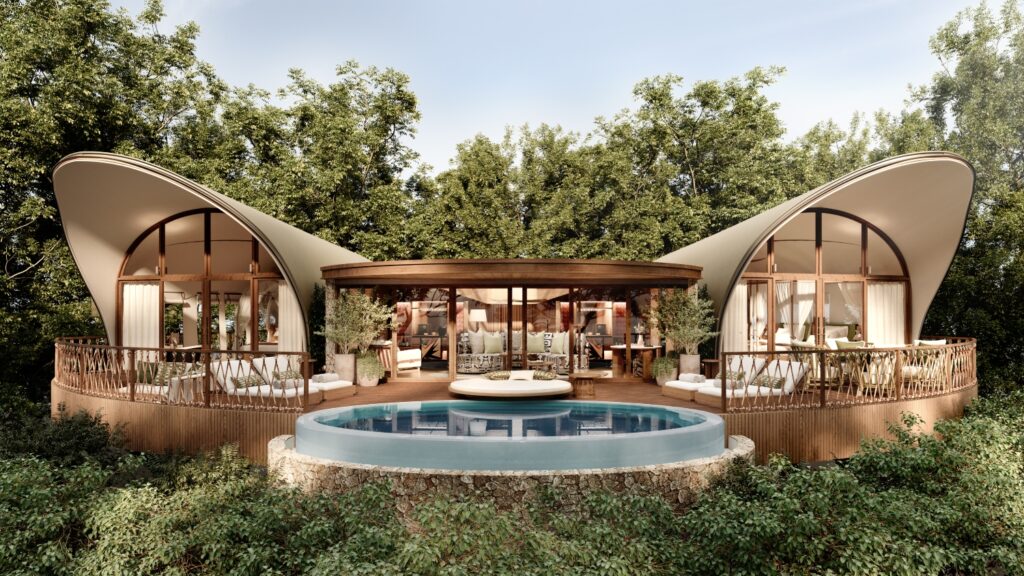
The Kenya Wildlife Service (KWS) has dismissed claims that the newly built Ritz-Carlton Maasai Mara Safari Camp is obstructing a critical wildebeest migration corridor, defending the development as fully compliant with environmental and regulatory requirements.
In a statement released on Thursday, KWS said the camp lies within a “designated tourism investment low-use zone” as defined under the Maasai Mara National Reserve Management Plan 2023–2032.
KWS emphasized that all required environmental impact assessments (EIAs), planning and regulatory approvals had been secured before construction began, and that the camp does not interfere with protected habitats or known migration pathways.
The development has sparked strong criticism from a coalition of conservationists, researchers and local activists, notably Maasai Education, Research and Conservation Institute (MERC).
They argue that the camp is situated along a historically critical migration corridor between Kenya’s Maasai Mara and Tanzania’s Serengeti, a path traversed annually by hundreds of thousands of wildebeest, zebras, and other species.
In an August 2025 lawsuit filed at the Environment and Land Court in Narok, MERC urged the court to suspend the lodge’s opening, claiming that no credible Environmental Impact Assessment (EIA) had been made public and that the development contravened a moratorium on new tourism accommodation in sensitive parts of the reserve, a moratorium adopted under the 2023-2032 management plan.
Critics also point to a recent social media video showing wildebeest apparently hesitating or retreating near parts of the camp’s perimeter, interpreting this as evidence of blocked passages — though KWS maintains the footage reflects older, unrelated events from past years.
Both the local government — represented by Narok County Government — and the camp’s developers contend that the project followed all required procedures.
In earlier responses, the county described the allegations as “unfounded, malicious and self-serving,” noting that the camp is a lawful lessee under a valid agreement and operates within zoning and environmental laws.
The Environmental Impact Assessment for the lodge was reportedly conducted under the guidelines of the National Environment Management Authority (NEMA), with public participation forums held in 2024. Officials say the site was found to lie outside sensitive wildlife corridors.
KWS reiterated that migration maps — based on over two decades of data — show no blockage, and under the 2023–2032 management plan, the lodge qualifies as low-impact tourism infrastructure.
The litigation against the Ritz-Carlton camp is still active, with MERC and other conservation stakeholders seeking to have the court nullify the lease and order restoration of the land to its natural state.




Leave a Reply